Pregnancy Discrimination vs. PDL Interference: A California Employer Guide
FEHA / EEO Defense

A California employee announces her pregnancy, requests leave, and returns to find that her position has changed. Depending on the facts, the employer may face separate questions about pregnancy discrimination, Pregnancy Disability Leave (PDL) rights, and reasonable accommodation.
Pregnancy discrimination focuses on whether pregnancy or a related condition motivated an adverse employment decision. PDL interference focuses on whether the employer denied or impaired a right protected by California's pregnancy-leave law. A separate failure-to-accommodate claim may arise if the employee needs an adjustment or additional leave because of a pregnancy-related disability.
For employers, these distinctions matter because PDL compliance does not automatically resolve every obligation under FEHA. This guide explains how the claims differ, how PDL interacts with CFRA and federal law, and what employers should document before deciding on leave or reinstatement.
Key Takeaways
Pregnancy discrimination asks why you acted, and PDL interference asks whether you denied or impaired a guaranteed right.
PDL provides up to four months (17⅓ weeks) per pregnancy for employers with five or more employees, with no tenure requirement.
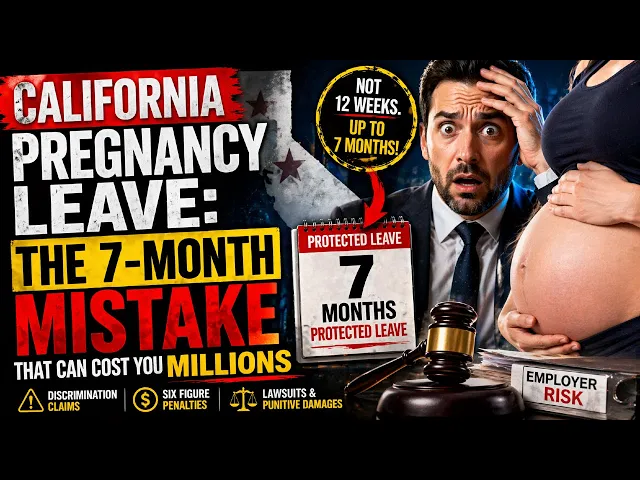
PDL doesn't count toward the 12 weeks of CFRA bonding leave, so eligible employees can take roughly 7 months in total.
Exhausting PDL doesn't make termination safe, because FEHA may require additional leave as an accommodation.
The PWFA covers employers with 15 or more employees, and EEOC pregnancy-related suits rose in FY 2026.
The strongest defense is a written, independent reason established before the pregnancy announcement, along with compliant notices and leave records.
What's the Difference Between Pregnancy Discrimination and PDL Interference in California?
Pregnancy discrimination and Pregnancy Disability Leave (PDL) interference can arise from the same employment decision, but they ask different legal questions.
Pregnancy discrimination concerns whether pregnancy, childbirth, or a related medical condition was a motivating factor in an adverse employment decision. Under the Fair Employment and Housing Act (FEHA), employers may not discriminate against employees because of pregnancy or related conditions.
PDL interference concerns whether the employer denied or impaired a right protected by California's Pregnancy Disability Leave law, such as qualifying leave or applicable reinstatement rights. An employer's motive may be relevant to a broader discrimination or retaliation claim, but it does not address whether the employer denied a protected leave right.
Issue | Pregnancy Discrimination | PDL Interference |
|---|---|---|
Legal basis | FEHA, including Gov. Code §12940(a) and pregnancy protections | Gov. Code §12945 and implementing regulations |
Core question | Did pregnancy or a related condition motivate the challenged employment decision? | Did the employer deny or interfere with a right protected by PDL? |
Typical example | An employee is demoted because she announces her pregnancy | An eligible employee is denied qualifying PDL or applicable reinstatement rights |
Evidence to examine | Decision records, timing, comparators, statements, and inconsistent explanations | Leave requests, medical certification, notices, leave calculations, and reinstatement records |
Defense focus | A legitimate, consistently applied reason supported by contemporaneous evidence | Compliance with the specific leave and reinstatement requirements |
The same facts may support both claims. An employer that denies leave and later terminates the employee, for example, may face questions about both compliance with PDL and whether pregnancy or leave-related protected activity motivated the termination.
How Long Is Pregnancy Disability Leave in California, and Who Qualifies?
California employers with five or more employees must generally provide eligible employees with up to four months of PDL per pregnancy when they are disabled by pregnancy, childbirth, or a related medical condition. There is no minimum tenure or hours-worked requirement.
Four months is calculated using the employee's average weekly hours; for a full-time employee, that's about 17⅓ weeks. The actual leave entitlement depends on the employee's pregnancy-related disability and medical need.
Coverage: Employers with five or more employees. No tenure, hours, or full-time requirement.
Per pregnancy, not per year.
More generous policies control. If you give more than four months for other temporary disabilities, pregnancy gets the same leave.
Medical certification: The employer may request appropriate medical certification of the need for PDL, subject to the applicable regulatory requirements. Review the certification promptly and do not reject a compliant certification simply because the employer prefers a different format.
Reinstatement: Employees generally have a right to return to the same position after PDL, subject to the regulatory provisions governing reinstatement. A comparable position may be permitted in specified circumstances. Employers should document any claimed position elimination or other asserted exception and confirm that it is unrelated to the employee's pregnancy or leave.
Group health coverage: Where you provide it, you must maintain it during PDL for up to four months (2 CCR §11044). This is separate from any CFRA coverage entitlement.
Pay: PDL itself is generally unpaid, although employees may qualify for state Disability Insurance benefits or use applicable accrued paid leave. Wage-replacement benefits are separate from the employer's job-protection and accommodation obligations.
Does an Employee Get PDL Plus 12 Weeks of Bonding Leave?
Yes. An employee who uses the full four months of PDL and independently qualifies for CFRA bonding leave may be entitled to up to 12 additional weeks of job-protected leave.
Together, those periods can total about 29⅓ weeks (roughly seven months), but the actual entitlement depends on the employee's medical need, leave used, and CFRA eligibility. Employers should track PDL, FMLA, and CFRA separately because the laws overlap differently.
Watch: California Pregnancy Leave: The 7-Month Rule That Can Cost You Millions explains why the 12-week assumption is one of the most dangerous misunderstandings in this area.
For how PDL, FMLA, and CFRA run together, see our guide to coordinating PDL, FMLA, and CFRA.
Which Employer Conduct Counts as PDL Interference?
Conduct | Why It's Risky | Safer Practice |
|---|---|---|
Denying or shortening leave | Refusing PDL is unlawful on its face | Grant leave when a provider certifies disability |
Capping leave at 12 weeks | Ignores the four-month PDL plus CFRA | Track PDL and CFRA separately |
Counting PDL against CFRA | They run separately | Designate each leave in writing |
Rejecting a compliant medical certification | You must accept one that satisfies the regulation | Review against 2 CCR §11050 |
No written notice of PDL rights | The employer notice is required (2 CCR §11051) | Distribute the notice and post it |
Refusing a requested transfer or accommodation | Gov. Code §12945(a)(3) | Run the interactive process |
Failing to reinstate | Return rights are guaranteed | Document any real elimination of the job |
Can You Fire a Pregnant Employee or One on PDL?
Only for a documented reason that has nothing to do with pregnancy or the leave, and the claim you must defend is usually both discrimination and interference. Two points matter:
Reinstatement has a narrow exception. The job can be eliminated for reasons unrelated to PDL, but you will need to prove that independent reason.
Exhausting PDL isn't a safe harbor. In Sanchez v. Swissport, Inc. (2013) 213 Cal.App.4th 1331, the Court of Appeal held that exhausting PDL does not automatically end an employer's obligations under FEHA. The employee had alleged pregnancy-related discrimination and that additional leave would have allowed her to return to work. The court held that her allegations could support separate FEHA claims, including failure to accommodate and failure to engage in the interactive process.
The practical lesson is not that every employee is automatically entitled to more leave after PDL. Employers must assess any continuing disability and accommodation request individually, including whether additional finite leave would likely permit the employee to return to work and whether it would impose an undue hardship.
Our guides on the interactive process and how long to hold a job for an employee on leave cover what to document before ending a leave, and our wrongful termination defense guide includes a pre-termination checklist.
How Does Federal Law Affect a California Employer?
The federal Pregnant Workers Fairness Act (PWFA) adds accommodation obligations for covered employers with 15 or more employees. It requires reasonable accommodation of a qualified employee's known limitations related to pregnancy, childbirth, or related medical conditions, unless the accommodation would cause undue hardship. Unlike the ADA, the PWFA does not require the pregnancy-related limitation itself to meet the ADA's definition of disability.
California employers may have overlapping duties under FEHA, PDL, Title VII, and the PWFA. They should assess each applicable requirement separately and avoid assuming compliance with one law satisfies obligations under another.
For employers, the practical response is to review accommodation procedures, train managers to recognize informal requests, document the interactive process, and avoid forcing an employee onto leave when an effective accommodation would allow her to continue working.
What Evidence Helps Defend Each Claim?
Claim | Evidence to Preserve and Review |
|---|---|
Pregnancy discrimination | Contemporaneous decision records; performance history; comparator treatment; relevant statements; decision-maker knowledge; and consistent explanations for the challenged action |
PDL interference | Leave request and dates; applicable notices; medical certification and leave calculations; designation records; communications about reinstatement; and the basis for any asserted exception |
Failure to accommodate | The employee's known limitations; options considered; the interactive-process record; proposed accommodations; operational impact; and any documented undue-hardship analysis |
Retaliation | The timing of protected activity and subsequent decisions; decision-maker knowledge; consistent application of policies; and contemporaneous evidence of the reasons for any adverse action |
A single timeline should identify when the employer learned of the pregnancy or disability, when leave or accommodation was requested, who made each employment decision, and what information was available at that time.
What Should You Do When a Pregnant Employee Asks for Leave or an Accommodation?
Respond promptly in writing, record the date, and start the interactive process.
Provide the required PDL notice and designate PDL and CFRA separately.
Request only job-related medical certification, and accept compliant forms.
Explore accommodations or a transfer before leave where the provider says she can keep working.
Track dates and reinstatement so return rights are honored.
Review every decision about the employee before it takes effect. Later changes can look retaliatory.
If you've received a CRD complaint, an EEOC charge, or an attorney's demand letter alleging pregnancy discrimination or interference with leave, DefendMyBiz offers a free 15-minute consultation. If you have a pending decision about a pregnant or recently returned employee and want a legal review before acting, or you'd like your pregnancy leave policy reviewed, that's a paid 1-hour consultation. Our FEHA / EEO Defense team handles both.
Conclusion
Pregnancy discrimination and PDL interference are distinct legal theories under California law. Discrimination concerns whether pregnancy or a related condition motivated an adverse employment decision; PDL interference concerns whether the employer denied or impaired a right protected by California's pregnancy-leave law. A single sequence of events may raise both claims, along with separate questions about reasonable accommodation or retaliation.
Exhausting PDL does not automatically end an employer's FEHA obligations. Employers should track PDL, FMLA, and CFRA separately, provide required notices, engage in the interactive process, and document the reasons for employment decisions and reinstatement outcomes.
Frequently Asked Questions
How long is pregnancy disability leave in California?
What is PDL interference?
Is PDL the same as CFRA leave?
Can I terminate an employee who has used all her PDL?
Does the federal Pregnant Workers Fairness Act apply to California employers?
Disclaimer: The above content is for informational purposes only. This is not legal or tax advice. Laws, IRS guidance, and withholding requirements can change, and outcomes depend on specific facts. You are advised to contact a qualified attorney for any legal advice.


