
California Meal and Rest Break Rules: What Every Employer Must Know
Wage & Hour Defense

Most California employers who get sued for meal and rest break violations didn't intend to break the law. They weren't tracking or documenting. And when the claim came in, they had nothing to show.
One missed meal break in California equals one hour of premium pay. Miss enough of them, and an employee claiming three years of unpaid breaks can turn a paperwork problem into a six-figure liability hearing. John Fagerholm has sat in those hearings. Here's what he's seen.
"My Employee Refused to Take Their Break. Am I Still On the Hook?"
Usually, yes, if the employer failed to provide a compliant meal period.
California law requires the employer to provide a compliant, duty-free meal period on time and without interference. A break cannot be merely theoretical or illusory, but the employer is also not required to police the employee once the employee has been relieved of duty.
John covered this directly:
"You are responsible if your employees don't take their meal break. Irrespective of whether it's you or the employee who wants to skip it."
Watch: Can My Employee Refuse Their Meal Breaks?
The break also has to happen on time. A meal break must occur before the end of the fifth hour of work. Starting it in hour six is a violation, even if the full 30 minutes is given.
What this means for you:
Your job is to make the break happen, document that it happened, and ensure it happened on time. Employee preference doesn't change your liability.
The Basic Rules: Meal Breaks and Rest Breaks Side by Side
Aspects | Meal Break | Rest Break |
|---|---|---|
Length | 30 minutes (unpaid, duty-free) | 10 minutes (paid) |
When required | Before the end of the 5th hour worked | Every 4 hours worked or a major fraction thereof (which DLSE interprets as more than 2 hours) |
Tracking required? | Yes | Not legally required, but strongly recommended |
Penalty for violation | 1 hour of premium pay per workday for a meal-period violation | Separately, 1 hour per workday for a rest-period violation |
Waiver allowed? | Yes, for shifts of 6 hours or less by mutual consent | No |
For an 8-hour shift, one 30-minute meal break and two 10-minute rest breaks are required.
What "Premium Pay" Actually Costs You Now
Premium pay used to be calculated at an employee's base hourly rate. That changed.
In Ferra v. Loews Hollywood Hotel (2021), the California Supreme Court ruled that premium pay must be calculated at the regular rate of pay, the same rate used for overtime calculations. That rate includes:
Base hourly wages
Shift differentials
Piece-rate compensation
Commissions
Non-discretionary bonuses
If your employee earns a $500 monthly performance bonus, that bonus factors into what you owe for every missed break.
John called it what it is:
"This certainly creates a nightmare of complex and cumbersome scenarios... the biggest issue is that this clarification makes this law retroactive."
Watch: Meal and Rest Breaks Premium Pay
Retroactive. Meaning past missed breaks, calculated at a rate employers never planned for. If you have employees who receive any form of variable pay and your break compliance has gaps, this is worth reviewing now.
"Do I Have to Track 10-Minute Breaks?"
Technically, no. California law doesn't require employers to track rest breaks.
John's advice: track them anyway.
"As long as you're tracking the lunch breaks, track the 10-minute breaks too. Why even have trouble proving that you gave them their 10-minute breaks if it's right there in writing, dated and signed?"
Watch: 10-minute break rules for California employers

The violation penalty is one hour of pay per missed rest break. If an employee claims they never received a single rest break over three years of employment and you have no documentation showing otherwise, you're left arguing against an uncorroborated claim with no paper trail.
The practical standard: if you're already using a time system for meal breaks, add rest breaks to the same log. The marginal effort is low. The protection is real.
What Happens When You Have No Documentation: A Real Case
John filmed this one right after leaving a labor board hearing. His client owned a maintenance company. An employee claimed he had never received a single meal break or rest break across three years of employment.
Overtime and double-time? Easy to disprove. Simple math.
Meal and rest breaks? Different problem.
"He basically just said he wasn't allowed to take any of his meals or 10-minute breaks, and since it wasn't tracked, that's probably where we're going to have our problem."
Watch: The Proper Way To Track Your Employee Breaks
Three years of employment. No documentation. The employee's word against the employer's. That's what the absence of a break log creates.
John's recommendation from that hearing: if employees work off-site or a punch system isn't practical, use a weekly log sheet. Employees sign it, confirm breaks were taken, date it, and submit it. Low-tech, legally defensible.
The Domino Effect: How One Missed Break Becomes a Much Bigger Claim
John's quick-tip video put it plainly:
"One missed meal break equals one hour of premium pay and one day of pay for every day that premium is not paid when it is due."
Watch: Employer Law: Missed Meal & Rest Break Lawsuits

The penalty compounds. Premium pay not paid on time triggers additional waiting time penalties. If the same pattern affects multiple employees, it becomes a PAGA claim. One employee, acting as a representative, can bring claims on behalf of every worker affected by the same practice.
The Santa Cruz Seaside Company settled for $6 million. Allegations included missed breaks, unpaid overtime, and delayed final paychecks.
"Small oversights can snowball into massive liabilities."
Watch: The Importance of Timekeeping and Employee Breaks
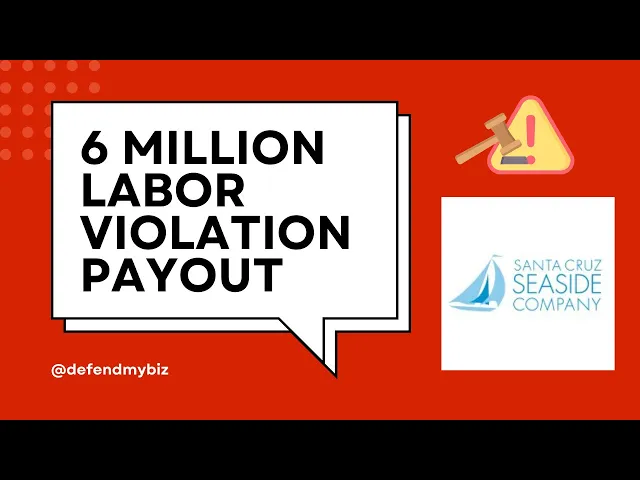
That settlement is a real-world illustration of what happens when broken compliance is treated as a low-priority administrative detail.
What a Defensible Break Policy Actually Looks Like
You don't need a complicated system. You need a consistent one.
For meal breaks:
Written policy stating break timing requirements (before the end of the fifth hour)
Punch-out and punch-in records for every meal break, every day
For off-site employees: signed weekly log sheets confirming breaks taken
Written waivers, signed by the employee, for any legitimate waiver scenario (shift of 6 hours or less)
For rest breaks:
Written policy stating employees are entitled to 10-minute breaks every four hours
Tracking isn't legally required, but a simple log adds meaningful protection
Manager training on what "providing" a break means (not just announcing it's available)
On the premium pay calculation:
Review whether any employees receive variable compensation (bonuses, commissions, shift differentials)
Confirm your premium pay calculation accounts for all non-discretionary income in the regular rate
If your calculation method hasn't been reviewed since Ferra, it's worth checking
If a break-compliance question is already becoming more formal, the wage-and-hour defense team at DefendMyBiz works exclusively on the employer side. That distinction matters when the strategy is being built.
Conclusion
California's meal and rest break rules are not complicated in theory. What makes them expensive is the gap between knowing the rules and actually documenting compliance. When an employee files a three-year claim and your records are incomplete, the burden shifts to you.
John has stood in those hearings. The employers who lose them usually didn't intend to do anything wrong. They just didn't have the documentation to prove they didn't. A clean break policy, a consistent tracking system, and a premium pay calculation that accounts for variable compensation costs almost nothing to put in place.
Defending against three years of claims without it costs considerably more. Our team defends California employers exclusively. Book a free 15-minute consultation.
FAQs
What happens if an employee voluntarily skips their meal break?
Can employees waive their meal break?
What's the penalty for a missed rest break?
Do I have to track rest breaks?
Can a single break violation turn into a class or PAGA claim?
Disclaimer: The above content is for informational purposes only. This is not legal or tax advice. Laws, IRS guidance, and withholding requirements can change, and outcomes depend on specific facts. You are advised to contact a qualified attorney for any legal advice.